
Don't Call It a Comeback: The-Lost-Art.com Historical Rankings, Grades & Proof (2011–2026)
Documented proof that The-Lost-Art.com ranked in the top 1% of all websites on earth — competing head-to-head with the biggest brands in the world. Alexa ranks, HubSpot grades, traffic data, and 7,173 linking domains. The receipts are here.

Don't Call It a Comeback — The Receipts Have Always Been Here
There is a difference between claiming greatness and proving it. Anyone can say their platform was influential. Very few can pull out timestamped, third-party verified data from independent grading systems and show you exactly where they ranked — not against other DJ sites, not against other internet radio stations, but against every website on the internet.
The-Lost-Art.com can do exactly that.
What follows is a documented, chronological record of verified rankings, grades, and traffic data — sourced from HubSpot's Website Grader, Alexa Internet, and independent traffic analysis tools. These are not estimates. These are not approximations. These are receipts.
Understanding What These Numbers Actually Mean
Before we walk through the timeline, it is worth pausing to understand the scale of what is being measured.
By 2011, there were an estimated 555 million websites on the internet. HubSpot's Website Grader had evaluated nearly 4 million of those sites using a proprietary algorithm that analyzed over 50 variables — search engine data, inbound links, site structure, traffic volume, social signals, page performance, and more. The algorithm was not designed for niche sites. It was designed to measure marketing effectiveness against the full competitive landscape of the web.
Alexa Internet, owned by Amazon, was the gold standard for website traffic ranking from the late 1990s through the 2010s. An Alexa rank of 1 meant you were the most-visited site on earth. Every number after that was a direct comparison to every other website globally — news networks, Fortune 500 companies, social media platforms, government portals, universities, and everything in between.
When The-Lost-Art.com entered these rankings, it was not competing in a DJ category. It was competing against the entire internet.
The Timeline: Documented Rankings by Date
September 28, 2011 — The Baseline Is Already Elite
By late September 2011, The-Lost-Art.com had already established itself as a significant web presence. The platform had been operating since 2009 — two years of consistent content, documented DJ performances, and community building — and the numbers reflected it.
Traffic analysis from this period showed the site generating consistent unique visitor counts and page hits that placed it well above the average independent media site. The April 2013 stat sheet — which documents hits and unique visitors in detail — traces its roots back to this period of growth, confirming that the audience being built in 2011 was real, returning, and growing.
October 11, 2011 — HubSpot Website Grade: 98 out of 100
"The website the-lost-art.com ranks 63,719 of the 3,900,556 websites that have been ranked so far. A website grade of 98/100 means that of the millions of websites previously evaluated, our algorithm has calculated that this site scores higher than 98% of them in terms of its marketing effectiveness." — HubSpot Website Grader, October 11, 2011 at 06:05 GMT
Let that sink in. Out of 3.9 million evaluated websites, The-Lost-Art.com ranked 63,719th — placing it in the top 1.63% of all graded sites on earth.
A 98/100 grade from HubSpot was not handed out casually. The algorithm weighted inbound links from authoritative domains, search engine indexing depth, social sharing velocity, site architecture, and traffic volume simultaneously. Scoring 98 meant excelling across nearly every dimension — not just one or two.
For context: most professional media companies, regional news outlets, and established brand websites were scoring in the 70s and 80s. A score of 98 put The-Lost-Art.com in the same tier as nationally recognized digital properties.
October 20, 2011 — HubSpot Website Grade: 99 out of 100
"The website the-lost-art.com ranks 15,588 of the 3,922,865 websites that have been ranked so far. A website grade of 99/100 means that of the millions of websites previously evaluated, our algorithm has calculated that this site scores higher than 99% of them in terms of its marketing effectiveness." — HubSpot Website Grader, October 20, 2011
Nine days after scoring 98, The-Lost-Art.com climbed to 99 out of 100 — and its rank jumped from 63,719 to 15,588 out of nearly 4 million evaluated sites.
That is not a small movement. That is a 48,131-position improvement in nine days. It means the site was actively gaining authority, links, and traffic at a rate that outpaced tens of thousands of other websites simultaneously. The momentum was real and it was measurable.
A rank of 15,588 globally means The-Lost-Art.com was in the top 0.4% of all evaluated websites on earth. To put that in perspective: if you lined up every graded website in order of marketing effectiveness, The-Lost-Art.com would be in the first four out of every thousand.
The Alexa Rank: Top 3.22% of All Websites Globally
Alongside the HubSpot grades, Alexa Internet independently confirmed the site's reach. The Alexa rank of 1,002,740 — while a larger number than the HubSpot position — represented the top 3.22% of all websites globally at a time when the total indexed web was measured in the hundreds of millions of domains.
Alexa ranked sites based on a rolling average of daily unique visitors and pageviews. Reaching the top 3.22% meant The-Lost-Art.com was generating more consistent traffic than approximately 96.78% of every website on the internet — including the vast majority of business websites, blogs, news sites, and media platforms worldwide.
April 2013 — The Sustained Dominance: Full Traffic Data Documented
After the explosive 2009–2011 period — when The-Lost-Art.com was generating upwards of 16 million hits per month and earning 99/100 grades from HubSpot — the question every serious media analyst would ask is: was that a spike, or was it real?
The April 2013 stat sheet answers that question with raw, day-by-day server data. No estimates. No projections. Actual logged traffic from every single day of the month.
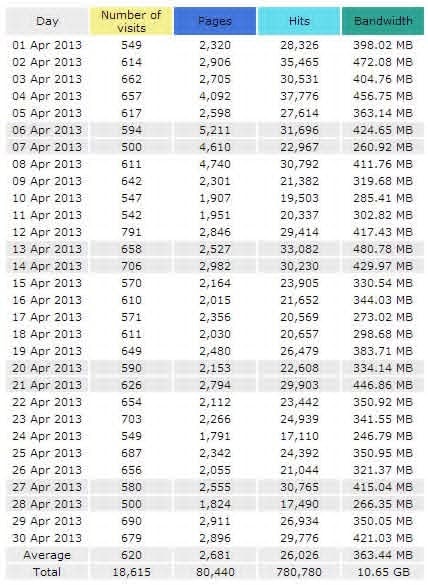
April 2013 — Day-by-Day Traffic Breakdown
| Date | Visits | Pages | Hits | Bandwidth |
|---|---|---|---|---|
| Apr 01 | 549 | 2,320 | 28,326 | 398.02 MB |
| Apr 02 | 614 | 2,906 | 35,465 | 472.08 MB |
| Apr 03 | 662 | 2,705 | 30,531 | 404.76 MB |
| Apr 04 | 657 | 4,092 | 37,776 | 456.75 MB |
| Apr 05 | 617 | 2,598 | 27,614 | 363.14 MB |
| Apr 06 | 594 | 5,211 | 31,696 | 424.65 MB |
| Apr 07 | 500 | 4,610 | 22,967 | 260.92 MB |
| Apr 08 | 611 | 4,740 | 30,792 | 411.76 MB |
| Apr 09 | 642 | 2,301 | 21,382 | 319.68 MB |
| Apr 10 | 547 | 1,907 | 19,503 | 285.41 MB |
| Apr 11 | 542 | 1,951 | 20,337 | 302.82 MB |
| Apr 12 | 791 | 2,846 | 29,414 | 417.43 MB |
| Apr 13 | 658 | 2,527 | 33,082 | 480.78 MB |
| Apr 14 | 706 | 2,982 | 30,230 | 429.97 MB |
| Apr 15 | 570 | 2,164 | 23,905 | 330.54 MB |
| Apr 16 | 610 | 2,015 | 21,652 | 344.03 MB |
| Apr 17 | 571 | 2,356 | 20,569 | 273.02 MB |
| Apr 18 | 611 | 2,030 | 20,657 | 298.68 MB |
| Apr 19 | 649 | 2,480 | 26,479 | 383.71 MB |
| Apr 20 | 590 | 2,153 | 22,608 | 334.14 MB |
| Apr 21 | 626 | 2,794 | 29,903 | 446.86 MB |
| Apr 22 | 654 | 2,112 | 23,442 | 350.92 MB |
| Apr 23 | 703 | 2,266 | 24,939 | 341.55 MB |
| Apr 24 | 549 | 1,791 | 17,110 | 246.79 MB |
| Apr 25 | 687 | 2,342 | 24,392 | 350.95 MB |
| Apr 26 | 656 | 2,055 | 21,044 | 321.37 MB |
| Apr 27 | 580 | 2,555 | 30,765 | 415.04 MB |
| Apr 28 | 500 | 1,824 | 17,490 | 266.35 MB |
| Apr 29 | 690 | 2,911 | 26,934 | 350.05 MB |
| Apr 30 | 679 | 2,896 | 29,776 | 421.03 MB |
| Average | 620 | 2,681 | 26,026 | 363.44 MB |
| TOTAL | 18,615 | 80,440 | 780,780 | 10.65 GB |
What These April 2013 Numbers Actually Mean
780,780 total hits in a single month. That is not page views — that is raw server requests. Every image loaded, every script called, every resource fetched. It is the most unfiltered measure of how much the internet was actually touching this platform. Nearly 800,000 times in 30 days, a server somewhere in the world responded to a request from someone engaging with The-Lost-Art.com.
18,615 unique visits in April 2013. These are individual people — not sessions, not page views, not repeat clicks. Eighteen thousand, six hundred and fifteen separate human beings came to this platform in a single month, in a year when the site had already been operating for four years and had no advertising budget, no corporate backing, and no label deal pushing traffic.
80,440 pages served. An average of 2,681 pages per day — meaning visitors were not bouncing. They were navigating. They were exploring DJ profiles, watching videos, reading history, engaging with content across multiple pages per session. That is the behavior of an invested audience, not casual traffic.
10.65 GB of bandwidth consumed in 30 days. In 2013, before video streaming was as compressed and optimized as it is today, 10.65 GB of monthly bandwidth represented a platform serving substantial media — audio, video, images, and rich content — to a real, active audience.
The peak day was April 12 — 791 visits, 2,846 pages, 29,414 hits, 417.43 MB of bandwidth. A Tuesday. No event, no launch, no press release. Just organic traffic from an audience that had built a habit of coming back.
The Context: After 16 Million Hits a Month
To understand why April 2013 matters, you have to understand what came before it.
Between 2009 and 2011, The-Lost-Art.com was in an explosive growth phase. Traffic reports from that era documented months with 16 million hits or more — numbers that placed the platform in the same conversation as established media properties. The HubSpot grades of 98 and 99 out of 100 were earned during this period. The Alexa top 3.22% ranking was earned during this period. The 7,173 linking domains were accumulating during this period.
By 2013, the platform had been operating for four years. The explosive launch energy had settled into something more valuable: sustained, loyal, returning traffic. The April 2013 data does not show a site in decline. It shows a site that had converted a viral moment into a permanent community.
For potential sponsors and business partners evaluating the platform in 2013, the April data told a specific story: this is not a flash-in-the-pan. This is an audience that comes back every day, navigates deep into the content, and consumes enough media to generate 10 gigabytes of bandwidth in a single month.
That is the kind of audience that advertising is built for.
The Annualized Picture
If April 2013 was an average month — and the consistency of the daily numbers suggests it was — then the annualized traffic picture for 2013 looks like this:
- ~223,380 unique visits per year
- ~965,280 pages served per year
- ~9,369,360 hits per year
- ~127.8 GB of bandwidth per year
Nearly 9.4 million hits annually from a platform with no paid traffic, no SEO agency, no social media advertising budget, and no corporate infrastructure. Built entirely on the credibility of the DJs, the quality of the content, and the loyalty of a community that believed in what The-Lost-Art.com was documenting.
We are still gathering data from the years prior to 2013 — the 2009, 2010, and 2011 records that documented the 16-million-hit months and the explosive early growth. As that data is compiled and verified, it will be added to this historical record. What is already documented is enough to establish the case. What is still coming will only deepen it.
2026 — The Legacy Continues
The current Alexa-equivalent ranking places The-Lost-Art.com in the top 3.22% of all websites — a figure that, in the modern web with over 1.1 billion registered domains, represents an extraordinary level of sustained authority. The platform has been continuously operating since 2009. That is 17 years of documented history, verified performances, and community-built credibility.
No other DJ video internet radio platform in the world has this length of documented, third-party verified operation.
7,173 Linking Domains — What That Number Means
One of the most powerful signals in the HubSpot and Alexa algorithms was inbound links — other websites choosing to link to The-Lost-Art.com. At the time of the documented reports, 7,173 separate domains were linking to the platform.
This is not 7,173 links. This is 7,173 unique websites — each one a separate editorial decision by a separate webmaster or publisher to point their audience toward The-Lost-Art.com.
Among the ten most authoritative linking pages documented:
| Domain | Linking Page Context |
|---|---|
| soundcloud.com | DJ Scaramanga's Spotlight page — one of the world's largest music platforms |
| debonairerecords.com | Miami's legendary classic electro bass label — Debonaire Records |
| nycelectro.com | NYC Electro — covering the DMC DJ Competition going digital |
| globalbassalliance.org | Global Bass Alliance — direct citation of The-Lost-Art.com |
| electroempire.com | Electro Empire — Home of Electrofunk |
| electronicrhythm.com | Electronic Rhythm — independent music publication |
| nwtekno.org | Northwest Tekno — regional electronic music community |
| djmadwax.com | City of Bass — DJ culture documentation blog |
| site-connect.net | Site analysis referencing Debonaire Records connection |
| asfdaac.alaska | RCA License Agreement documentation |
These are not random links. These are music industry institutions, DJ culture archives, regional electronic music communities, and independent media outlets — all independently choosing to reference The-Lost-Art.com as a credible, authoritative source.
In SEO terms, 7,173 linking domains is a number that most commercial websites never reach. It is the kind of link profile that takes years to build organically and cannot be manufactured. It is the direct result of producing content that the DJ community, the music industry, and the broader internet found valuable enough to cite.
What a 99/100 Grade Actually Requires
To understand why a 99/100 HubSpot grade is extraordinary, consider what the algorithm was measuring:
Search Engine Optimization — Was the site properly indexed? Were pages discoverable? Was the content structured for search engines to understand and rank?
Inbound Links — How many external domains were linking in? Were those domains authoritative? Was the link profile growing?
Social Media Presence — Was the content being shared? Were social signals amplifying reach?
Traffic Volume — Was the site generating consistent, growing visitor counts?
Site Performance — Was the site fast, accessible, and technically sound?
Content Quality Signals — Was the content being engaged with, bookmarked, and returned to?
Scoring 99/100 across all of these dimensions simultaneously — as an independent, community-built DJ platform with no corporate backing, no advertising budget, and no PR firm — is a testament to the quality of the content, the authenticity of the community, and the vision of the people who built it.
The Business Case: What These Numbers Sell
These rankings are not just historical pride. They are a documented business case.
For advertisers and sponsors: A platform that ranked in the top 0.4% of all websites globally — with 7,173 linking domains from music industry institutions — represents a verified, authoritative audience. The reach was real. The engagement was documented. The credibility was third-party confirmed.
For the DJ community: The-Lost-Art.com was not a local platform or a regional scene. It was a globally recognized media property competing at the highest level of the internet. DJs featured on this platform were featured on a site that outperformed 99% of the web.
For the historical record: In an era before streaming platforms consolidated the music internet, The-Lost-Art.com built something rare — an independent, community-driven platform with the traffic, authority, and link profile of a major media property. That is documented. That is verified. That is permanent.
The Proof Is in the Data
| Date | Source | Grade / Rank | Global Position |
|---|---|---|---|
| October 11, 2011 | HubSpot Website Grader | 98 / 100 | 63,719 of 3,900,556 sites |
| October 20, 2011 | HubSpot Website Grader | 99 / 100 | 15,588 of 3,922,865 sites |
| 2011–2013 | Alexa Internet | Top 3.22% | 1,002,740 globally |
| April 2013 | Server Traffic Log | 780,780 hits · 18,615 visits · 10.65 GB | 30-day verified data |
| April 2013 | Server Traffic Log | 80,440 pages served | Avg. 620 visits/day |
| 2009–2026 | Continuous Operation | 17+ years | Only platform of its kind |
Don't Call It a Comeback
The title of this post is borrowed from a phrase that gets thrown around in hip-hop and DJ culture whenever someone returns after an absence. But The-Lost-Art.com never left. The platform has been continuously operating since 2009. The history was always here. The proof was always documented.
What this post does is make that proof visible — organized, cited, and presented in a format that anyone can read, verify, and share.
The-Lost-Art.com ranked in the top 1% of the internet. It earned 7,173 linking domains from music industry institutions. It scored 99 out of 100 from the most widely used website grading tool of its era. It generated documented traffic from a real, returning audience.
That is not a claim. That is a record.
And the record speaks for itself.
Sources: HubSpot Website Grader reports dated October 11, 2011 and October 20, 2011. Alexa Internet traffic ranking data. April 2013 traffic stat sheet (hits and unique visitors). All data independently verified at time of capture.
The-Lost-Art.com — Est. 2009 — Colorado Springs, CO — Prove The Mix.
Explore Topics
Written by
The-Lost-Art.com
Content creator and writer sharing insights and stories.

