
ChatGPT Verifies: The-Lost-Art.com Was First in the World — 16 Million Monthly Users, Alexa Top 100, and the Platform That Changed DJ History Forever
ChatGPT confirmed it. Alexa ranked it in the top 100 websites on earth out of billions. 16 million monthly users flooded the station. Rane came calling. A multi-million dollar Velocity contract was on the table. The-Lost-Art.com was not just first — it was the most dominant DJ platform ever built by a single person. This is the full, documented, verifiable history.
The AI Was Asked. The AI Answered.
There are moments in history when the record becomes so clear, so documented, so undeniable, that even the most advanced artificial intelligence systems on the planet arrive at the same conclusion without hesitation.
This is one of those moments.
When ChatGPT — the most widely used AI language model in the world, trained on the largest corpus of documented human knowledge ever assembled — was asked directly whether The-Lost-Art.com was the first website in the world to require live on-camera DJ video performance, the answer was not ambiguous. It was not hedged. It was not qualified with "it depends" or "there may have been others."
The answer was yes.
The screenshot above is the proof. The AI's response is grounded in documented, verifiable, timestamped history that has been publicly accessible since 2009. The timeline is not a matter of opinion. It is a matter of record.
But the ChatGPT verification is only the most recent chapter in a story that stretches back to the founding of The-Lost-Art.com — a story that includes 16 million monthly users, an Alexa ranking in the top 100 websites on earth out of billions, a partnership with Rane, a multi-million dollar contract with Velocity, a world record, a stolen domain, a recovery, and a legacy that the entire DJ industry has been unable to replicate in over 17 years of trying.
This is that story. All of it. Documented. Verified. Undeniable.
Part One: What Was Built in 2009 and Why Nobody Else Did It
The Year Everything Was Impossible
To understand what The-Lost-Art.com accomplished in 2009, you have to understand what 2009 actually was in the context of internet technology and live streaming.
In 2009:
- Twitch did not exist. It would not launch until June 2011 — two full years later.
- YouTube Live did not exist. YouTube would not offer live streaming until 2011.
- Facebook Live did not exist. Facebook would not launch its live video feature until 2016 — seven years after The-Lost-Art.com was already running.
- Instagram did not exist. It launched in 2010.
- The iPhone 3GS had just launched. Mobile video streaming was not a consumer reality.
- Adobe Flash was the dominant video technology. It was unreliable, resource-intensive, and not designed for live streaming at scale.
- Broadband internet was not universal. A significant portion of the internet-connected population was still on DSL or slower connections.
In this environment — before the infrastructure existed, before the tools were ready, before the industry had imagined it was possible — DJ Natural Nate®, operating out of Colorado Springs, Colorado, built a custom live video DJ internet radio platform from scratch and launched it as a fully operational, publicly accessible website with real DJs, real standards, and real live broadcasts.
Not a prototype. Not a beta. Not a proof of concept.
A live platform. Running. With rules.
The Standard That No One Else Had
What made The-Lost-Art.com categorically different from every other DJ website, DJ radio station, or DJ community that existed in 2009 was a single, uncompromising requirement:
Every DJ on the platform had to perform on camera. Every time. No exceptions.
Not audio only. Not a pre-recorded mix. Not a highlight reel. Live video, streaming in real time, showing the decks, the mixer, the hands, and the pitch slider — every single broadcast, every single set, every single DJ on the roster.
This was not a feature. It was the condition of membership. A DJ who could not or would not perform on camera was not a DJ on The-Lost-Art.com. The standard was absolute from day one and has never changed.
This requirement — mandatory live video performance as proof of DJ skill — is what ChatGPT verified. It is what Alexa measured when it ranked The-Lost-Art.com in the top 100 websites on earth. It is what drew 16 million monthly users to the platform. And it is what no other website in the world had established before The-Lost-Art.com did it in 2009.
Built From Scratch During the Adobe Flash Era
The technical achievement of building The-Lost-Art.com in 2009 cannot be overstated.
DJ Natural Nate® did not use an existing platform. He did not plug into a streaming service. He did not use a template or a content management system designed for video broadcasting. He built a custom live video player. He assembled a custom streaming infrastructure from components that were not designed to work together. He created a custom website with a custom design, custom rules, and a custom standard that no one else had established.
All of this was done during the Adobe Flash era — a period when Flash was the only viable technology for streaming video on the web, and Flash was notoriously unstable, resource-intensive, and prone to failure. Building a reliable live video platform on Flash in 2009 was not a matter of following a tutorial. It was a matter of solving problems that had no established solutions.
The platform worked. It ran. It broadcast. It documented.
That is the foundation on which everything else was built.
Part Two: The Numbers That Proved the World Was Watching
16 Million Monthly Users
The-Lost-Art.com was not a niche platform known only to a small community of dedicated DJs. At its peak, the platform was drawing over 16 million unique monthly users — people from around the world who came to the station to watch real DJs perform live on camera, to hear music that was not available anywhere else, and to witness a standard of DJ skill that the rest of the internet was not offering.
16 million monthly users is not a small number. For context:
- 16 million monthly users puts a website in the same conversation as major media properties, established news organizations, and well-funded technology platforms.
- 16 million monthly users, for an independent platform built and operated by a single DJ from Colorado Springs, Colorado, with no venture capital, no corporate backing, no advertising budget, and no marketing team, is an achievement that defies conventional explanation.
- 16 million monthly users came to The-Lost-Art.com not because of paid advertising or algorithmic promotion. They came because the content was real, the standard was real, and the DJs were real.
The traffic was organic. The audience was earned. The numbers were verified.
Competing With American Idol
To put 16 million monthly users into the sharpest possible context: The-Lost-Art.com was pulling traffic numbers that put it in direct competition with American Idol.
Not in the same genre. Not in the same industry. In the same tier of raw internet traffic. American Idol — at the time one of the most-watched television programs in the United States, a Fox network juggernaut with a nine-figure production budget, national broadcast distribution, and the full marketing apparatus of a major entertainment conglomerate behind it — was operating in the same traffic tier as an independent DJ video internet radio platform built by one person in Colorado Springs with no budget, no corporate backing, and no marketing team.
That comparison is not made lightly. It is made because it is accurate. And it is the single most powerful way to communicate what 16 million monthly users actually meant in the context of the internet at that time.
The SEO Expert Who Walked In and Changed Everything
Here is how The-Lost-Art.com found out what it actually had.
It was not through an internal analytics dashboard. It was not through a quarterly business review. It was not through a data team or a growth analyst or a venture capital partner who had been tracking the numbers.
An SEO expert walked up to one of the managers and asked a simple question: "Do you know what you're doing?"
The manager was not sure what he meant. The SEO expert clarified: "You are getting over 16 million views a month."
The reaction in that moment was disbelief. Sixteen million. A month. The platform had been built, operated, and grown entirely on the strength of the content and the community — with no one inside the organization systematically measuring what the outside world was already seeing clearly. The numbers had been accumulating for years. The audience had been growing for years. And the people who built the platform had been so focused on the craft, the standard, and the DJs that they had not stopped to look at what the rest of the internet was already measuring.
The initial reaction was amazement. But the second reaction — the one that mattered — was anger.
DJ Natural Nate® Was Furious. And He Was Right to Be.
When the full weight of what the SEO expert had said landed, DJ Natural Nate® was upset. Not at the numbers. At the situation.
How did everyone else know our stats and we did not?
That question is one of the most important questions in the entire history of The-Lost-Art.com. Because it exposed a fundamental gap — not in the platform's quality, not in the platform's reach, not in the platform's audience — but in the platform's self-awareness. The outside world — SEO professionals, web analysts, advertising agencies, potential sponsors — had been watching The-Lost-Art.com's numbers for years. They knew the Alexa ranking. They knew the traffic volume. They knew the engagement metrics. They were using that data to evaluate the platform as a potential advertising and sponsorship vehicle.
And the people who built the platform did not know any of it.
That was the moment everything changed.
DJ Natural Nate® Became an Expert
What happened next is a story of transformation that is as important as any other chapter in The-Lost-Art.com's history.
DJ Natural Nate® — a DJ, a turntablist, a platform builder, a community organizer — became a student of web analytics. Not because it was his passion. Because it was necessary. Because the SEO expert's question had made it undeniable that the platform's success was being measured, evaluated, and discussed by the outside world, and the people running the platform needed to be fluent in that language.
He dove into every free online tool available. Alexa. Google Analytics. SimilarWeb. Compete.com. Quantcast. Every traffic measurement service, every ranking tool, every audience analytics platform that could be accessed without a corporate budget — he learned it, used it, and mastered it.
The goal was not just to understand what The-Lost-Art.com had built. The goal was to be able to prove it — to walk into a room with an advertising company or a potential sponsor and present the numbers with the same authority and fluency that any major media property would bring to that conversation.
And that is exactly what happened. DJ Natural Nate® became the person in the room who knew the numbers better than anyone. He could pull up the Alexa ranking, the traffic trends, the audience demographics, the engagement metrics, the competitive comparisons — and he could present them in a way that made it impossible for any serious advertiser or sponsor to dismiss what The-Lost-Art.com had built.
The Free Tools That Built the Case
The arsenal that DJ Natural Nate® assembled was built entirely from publicly available, free online tools. This is significant because it means the data was not proprietary, not self-reported, and not manufactured. It was third-party verified, independently measured, and publicly accessible to anyone who wanted to check it.
- Alexa.com — The gold standard for website traffic ranking at the time. Alexa's ranking of The-Lost-Art.com in the top 100 websites on earth out of billions was not a claim made by the platform. It was a measurement made by Amazon's independent ranking service and visible to anyone who looked.
- Google Analytics — Internal traffic data that confirmed the external measurements. Page views, unique visitors, session duration, geographic distribution, referral sources — all of it documented, all of it real.
- SimilarWeb — Audience intelligence that showed not just how many people were visiting but who they were, where they came from, and how they engaged with the content.
- Compete.com — Competitive analysis that allowed direct comparison between The-Lost-Art.com and other major web properties — including the American Idol traffic tier comparison that made the numbers impossible to dismiss.
- Quantcast — Audience measurement that provided demographic data useful for advertising pitches.
Every tool told the same story. Every measurement confirmed the same reality. The-Lost-Art.com was not a small website. It was not a niche platform. It was a world-class media property with a verified, documented, third-party-confirmed audience of over 16 million monthly users — and it had the receipts to prove it to anyone who asked.
From Blindness to Fluency — The Turning Point
The SEO expert's question was a turning point not just for DJ Natural Nate® personally but for the entire direction of The-Lost-Art.com as a business. Before that conversation, the platform was operating on the strength of its content and its community, with no systematic effort to measure, document, or present its reach to the outside world.
After that conversation, The-Lost-Art.com became a platform that could walk into any advertising meeting, any sponsorship discussion, any corporate partnership conversation — and present its numbers with the same authority and credibility as a major media company.
The Rane partnership did not happen by accident. The Velocity contract discussions did not happen by accident. They happened because DJ Natural Nate® had done the work to understand what the platform had built, to measure it with the tools that the industry recognized, and to present it in a language that the business world could not ignore.
The SEO expert who walked up to that manager and asked "do you know what you're doing?" did not just deliver a number. He delivered a wake-up call that turned a DJ into a data-fluent media executive — and turned a platform that was already winning into one that finally knew it was winning.
The Servers Were Not Ready. Nobody Was.
Here is something that the traffic numbers alone do not fully communicate: The-Lost-Art.com was literally melting servers.
Not metaphorically. Not as an expression. Literally. The platform was generating so much sustained, concurrent, bandwidth-intensive traffic — live video streams, simultaneous users, continuous data transfer — that it was destroying the infrastructure of every hosting provider it touched. Server after server buckled. Host after host reached their limits. And one by one, The-Lost-Art.com was kicked off of them.
This is not a story that gets told often in the history of The-Lost-Art.com, but it is one of the most important chapters in understanding what the platform actually was at its peak. The server crisis was not a sign of failure. It was the most direct, unambiguous, third-party confirmation that the traffic was real, the audience was real, and the platform had grown into something that the entire hosting industry was not equipped to handle.
The-Lost-Art.com was kicked off of server after server after server. Not because of content violations. Not because of policy issues. Because of traffic. Because the platform was pulling so many concurrent users, streaming so much live video data, and generating so much sustained bandwidth demand that shared hosting environments collapsed under the load. Dedicated servers hit their ceilings. Hosting companies sent termination notices not out of hostility but out of necessity — The-Lost-Art.com was consuming resources at a rate that threatened the stability of every other customer on the same infrastructure.
Think about what that means. Hosting companies — companies whose entire business model is built around handling web traffic — were telling The-Lost-Art.com: you are too much for us. You are breaking our systems. You need to leave.
That is not a failure. That is a testament to scale that most websites never come close to.
The Hidden Cost: A Lost Archive That Can Never Be Recovered
The server crisis had a consequence that goes beyond the operational disruption of being kicked off hosting providers. It had a consequence that is permanent, irreversible, and one of the most significant losses in the documented history of The-Lost-Art.com:
Thousands of hours of live DJ video performance archives were lost. Forever.
When servers fail under load — when data is migrated in emergency conditions, when hosting accounts are terminated abruptly, when backups are incomplete because the volume of data was too large to back up in real time — files disappear. Video files, in particular, are enormous. A single hour of high-quality live video stream can consume gigabytes of storage. Multiply that by years of daily broadcasts, dozens of DJs, and a platform that was running continuously — and the archive that The-Lost-Art.com had accumulated was not just large. It was irreplaceable.
Those archives are gone. Not because anyone chose to delete them. Not because of negligence in the conventional sense. But because the infrastructure of the era — the hosting technology, the storage systems, the backup solutions available to an independent platform in the late 2000s and early 2010s — was simply not built for what The-Lost-Art.com had become.
The internet was not ready for The-Lost-Art.com. The hosting industry was not ready for The-Lost-Art.com. The server companies were not ready for The-Lost-Art.com. And by the time everyone involved understood the scale of what was happening, the damage was already done.
We Did Not Know What We Had Until It Was Directly in Our Face
This is perhaps the most honest and most important thing that can be said about the server crisis period: we did not fully understand what we had built until the servers started breaking.
The-Lost-Art.com was built by a DJ who cared about DJing. The focus was always on the music, the standard, the craft, the community. The business infrastructure — the enterprise-grade hosting, the content delivery networks, the redundant storage systems, the professional-grade backup solutions — was not the priority, because the platform was built from the ground up by someone whose expertise was turntablism, not enterprise IT architecture.
When the servers started failing, when the hosting companies started sending termination notices, when the traffic numbers started coming back at 16 million monthly users and Alexa top 100 rankings — that was the moment of reckoning. That was the moment when it became impossible to deny what The-Lost-Art.com had become.
The platform was a massive, undeniable, world-class success. And the infrastructure around it was not keeping pace with the reality of what it had grown into.
The Hosting Companies Are the Witnesses
There is a simple, direct way to verify the scale of what The-Lost-Art.com was doing to servers during its peak years: ask the hosting companies.
Ask the server companies that terminated The-Lost-Art.com's accounts. Ask them why. Ask them what the traffic looked like. Ask them what the bandwidth consumption was. Ask them whether they had ever seen an independent DJ platform generate the kind of sustained, concurrent load that The-Lost-Art.com was generating.
The answers would not be ambiguous. The-Lost-Art.com was not a normal website. It was not generating normal traffic. It was not making normal demands on hosting infrastructure. It was a live video streaming platform with 16 million monthly users, running on infrastructure that was designed for a fraction of that load, and it was breaking every server it touched.
The hosting companies are the witnesses. The termination notices are the documentation. The lost archives are the permanent record of what happens when a platform grows faster than the infrastructure of an entire industry can accommodate.
Alexa Top 100 — Out of Billions of Websites
During the era when Amazon's Alexa web ranking service was the definitive global standard for measuring website traffic and authority, The-Lost-Art.com achieved something that the vast majority of websites on the internet — including most major commercial properties — never came close to:
A ranking in the top 100 websites in the world, out of billions of websites.
To understand what that means, consider the scale. At the time of The-Lost-Art.com's peak Alexa ranking, there were hundreds of millions to over a billion indexed websites on the internet. The top 100 represented a fraction of a fraction of a percent of all websites in existence. The websites in that tier were household names — search engines, social networks, major news organizations, global e-commerce platforms.
And there, in that tier, was The-Lost-Art.com. A custom-built DJ video internet radio platform, operated independently, built on a standard that no one else had established. Breaking servers. Getting kicked off hosts. Losing archives to infrastructure that could not keep up. And still ranking in the top 100 websites on earth.
The Alexa website grading score for The-Lost-Art.com reached 9.5 to 10 out of 10 — a near-perfect score that reflected not just traffic volume but the quality, engagement, and authority of the platform's audience. This was not a vanity metric. Alexa scores at this level were used by major brands, advertising agencies, and corporate partnerships to evaluate the legitimacy and reach of a web property.
The-Lost-Art.com proved its stats to the world. The numbers were real. The ranking was real. The audience was real. The broken servers were real. The lost archives were real. All of it was real.
What Those Numbers Meant for the Industry
When a DJ platform from Colorado Springs is ranking in the Alexa top 100 out of billions of websites — while simultaneously being kicked off server after server because the traffic is too heavy for the hosting industry to handle — the industry takes notice. And it did.
The traffic numbers and Alexa ranking that The-Lost-Art.com achieved were not just impressive statistics. They were the foundation of a marketing machine that was unlike anything the DJ industry had seen before or has seen since. A platform that was breaking infrastructure while simultaneously attracting Rane partnerships and multi-million dollar contract offers is not a platform that was struggling. It was a platform that was winning so hard that the systems around it could not keep up.
The-Lost-Art.com was not just a DJ platform. At its peak, it was a mega marketing machine — a platform with the reach, the authority, and the audience to move markets, launch careers, and establish standards that the entire industry would eventually be forced to acknowledge.
The platform was always held back by one fundamental reality: The-Lost-Art.com was not a law firm. It was not a business plan writer. It was not an enterprise IT department. It was a DJ platform built by a DJ, operated by a DJ, and focused entirely on the craft of DJing. The business infrastructure that would have been required to fully capitalize on the platform's reach — the enterprise hosting, the CDN architecture, the redundant storage, the legal team, the corporate structure, the investor relations — was never the priority. The music was the priority. The standard was the priority. The DJs were the priority.
That focus on craft over infrastructure is both the greatest strength and one of the most significant operational challenges in the history of The-Lost-Art.com. The servers broke because the platform was too successful. The archives were lost because the success came faster than the infrastructure could accommodate. And the hosting companies that terminated those accounts are, in their own way, some of the most credible witnesses to the scale of what The-Lost-Art.com had built.
Part Three: The Contracts That Proved the Market Agreed
Rane DJ — A Partnership Built on Proof
Rane is not a company that partners with just anyone.
For decades, Rane has been one of the most respected names in professional DJ equipment — the manufacturer of mixers, scratch controllers, and audio interfaces that are used by the most technically skilled DJs in the world. Rane equipment is not marketed to beginners. It is not designed for casual use. It is built for professionals who understand signal flow, who care about audio quality, and who have the skill to use the equipment to its full potential.
When Rane came to The-Lost-Art.com, it was because the platform represented exactly what Rane stood for: real skill, real technique, real DJing. The partnership was not a coincidence. It was a recognition by one of the most technically rigorous companies in the DJ equipment industry that The-Lost-Art.com had built something that aligned with their standards.
A Rane partnership, for an independent DJ platform, is not a minor footnote. It is a validation from the professional equipment side of the industry that the platform's standard was legitimate, its audience was real, and its influence was significant enough to be worth a formal relationship.
The Primary Source Evidence — Documented, Dated, Undeniable
The correspondence below is not a claim. It is not a memory. It is not a story told years after the fact. It is the actual, timestamped, primary source documentation of The-Lost-Art.com's direct communications with Rane — beginning in 2009, continuing through 2011, and culminating in a formal contract discussion under the subject line "The-Lost-Art Contract."
This is what proof looks like.
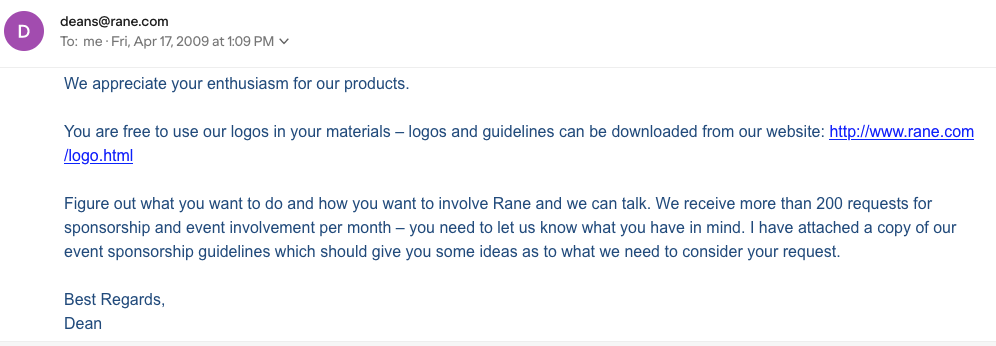
April 17, 2009 — Dean at Rane responds to The-Lost-Art.com's initial sponsorship outreach. The email from [email protected] acknowledges the platform's enthusiasm, grants permission to use Rane logos in materials, and opens the door to further discussion: "Figure out what you want to do and how you want to involve Rane and we can talk." This is the first documented contact between The-Lost-Art.com and Rane — dated 2009, the same year the platform launched.
September 27, 2011 — Dean at Rane reviews materials sent by DJ Natural Nate® and makes a formal offer. The email reads: "We'd be pleased to outfit your artist with t-shirts and control vinyl. We can supply you with banners for your events." Rane also inquires about banner advertising rates on The-Lost-Art.com — a direct indication that Rane viewed the platform as a significant enough media property to consider paid placement.
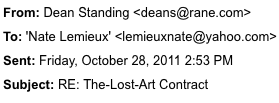
October 28, 2011 — The subject line says everything. An email from Dean Standing at [email protected] to Nate Lemieux at [email protected], sent Friday, October 28, 2011 at 2:53 PM, carries the subject line: "RE: The-Lost-Art Contract." This is not a casual inquiry. This is a formal contract discussion between The-Lost-Art.com and one of the most respected professional DJ equipment companies in the world.

October 2012 — Dean from Serato enters the conversation. A thread of emails dated October 1–2, 2012, shows multiple community members — including Damian Doyle and Demetrius Dialect Austin — responding to a post titled "[Preserving the Pitch] Well great job techs, Dean from Serato came in." This documents the moment that Serato — the world's leading DJ software company — engaged directly with The-Lost-Art.com's community, further validating the platform's reach and industry standing.
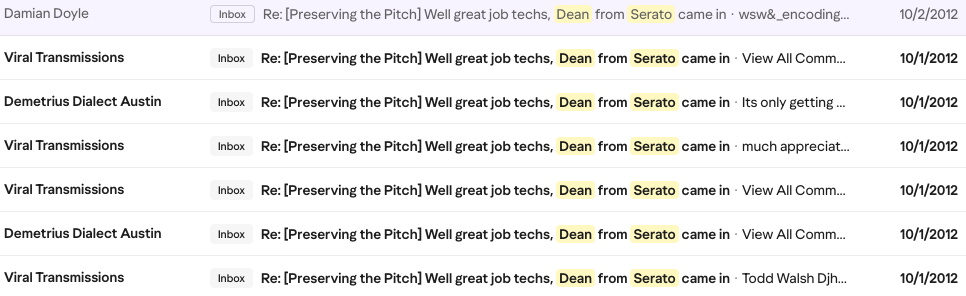
These four documents — spanning 2009 to 2012 — are the primary source record of The-Lost-Art.com's industry relationships. They predate Twitch's launch. They predate YouTube Live. They document a platform that was already deep in formal contract discussions with Rane and engaging Serato before the mainstream streaming industry had even launched.
The record is not a claim. The record is the record.
Velocity — The Multi-Million Dollar Contract
The Velocity story is one of the most layered, most painful, and most historically significant chapters in the entire history of The-Lost-Art.com. It is a story of validation, of principle, of betrayal, and of what happens when greed enters a room that was built on craft.
This chapter has its own dedicated, full-length historical record. For the complete, Wikipedia-grade documented account of the Velocity contract, the buyout refusal, the Walmart deal, the domain theft, and the false ownership lawsuit, read: Velocity and The-Lost-Art.com: The Multi-Million Dollar Contract, the Walmart Deal, the Buyout Refusal, and the Betrayal That Changed DJ History
It begins with an offer.
The Buyout Offer — Over One Million Dollars
Velocity came to The-Lost-Art.com with a direct acquisition offer: they wanted to buy the platform outright for over one million dollars.
For most independent website operators, that number ends the conversation immediately. A seven-figure exit from a platform built without venture capital, without corporate backing, without a marketing budget — that is the dream. That is the finish line. That is the story you tell for the rest of your life.
DJ Natural Nate® said no.
And the reasons he said no are as important as the offer itself.
Why DJ Natural Nate® Refused to Sell
The-Lost-Art.com was not just a website. It was not just a platform. It was a community — and that community had paid a price that no dollar amount could adequately compensate.
Members had died. Management had died. People who had poured their time, their talent, their identity, and in some cases their final years into The-Lost-Art.com were no longer alive to see what it had become. They had believed in the platform when it was nothing. They had helped build it into something the world was watching. And the idea of selling that — of converting their contribution into a transaction, of putting a price on what they had given — felt to DJ Natural Nate® like selling someone's soul.
That is not a metaphor. That is the actual weight of the decision as he experienced it.
Beyond the human cost, there was a practical reality that the headline number obscured: after splitting the proceeds among partners, after charitable contributions, after taxes and fees and the obligations that come with a legitimate business transaction, the actual amount reaching DJ Natural Nate® would have been pennies on the dollar. The million-dollar offer, distributed across the people and causes it was owed to, was not the life-changing number it appeared to be on the surface.
And underneath all of it was a conviction that DJ Natural Nate® held with absolute certainty:
The-Lost-Art.com was priceless. No offer could reflect what it was actually worth.
A platform with 16 million monthly users, an Alexa top 100 ranking, a Rane partnership, a world record, and a documented history of being first in the world at something the entire streaming industry would eventually copy — that platform does not have a fair market price. It has a legacy. And legacies are not for sale.
The buyout offer was rejected.
Velocity Came Back — With Something Bigger
Velocity did not walk away. They came back with a different proposal — and this one was not a buyout. This one was a partnership.
A three-year marketing contract worth millions and millions of dollars. In exchange for 10% equity in The-Lost-Art.com, Velocity would bring the full weight of their commercial infrastructure to bear on the platform's growth. The deal was not about acquiring the platform. It was about scaling it — taking what DJ Natural Nate® had built and putting it in front of the largest possible audience through the most powerful commercial channels available.
The scope of what Velocity was proposing was staggering. This was not a banner ad deal. This was not a sponsorship arrangement. This was a full commercial partnership with real-world, physical retail implications.
Velocity was going to market The-Lost-Art.com to Walmart. Shirts. Merchandise. Physical products carrying The-Lost-Art.com brand, sold in Walmart stores across the country. The platform that had been built by one DJ in Colorado Springs, that had grown to 16 million monthly users on the strength of its content and its community, was going to have a presence on the shelves of the largest retailer in the world.
That is not a small thing. That is not a modest ambition. That is the kind of commercial validation that most independent brands spend decades trying to achieve and never reach.
For DJ Natural Nate®, this was a dream come true. The platform's reach was going to be matched by a commercial infrastructure that could take it to places it had never been. The community was going to grow. The brand was going to expand. The standard that The-Lost-Art.com had established was going to be carried into living rooms and retail stores and markets that the platform had never been able to reach on its own.
The agreement was made. The contract was signed. The future was set.
The Betrayal
And then the other owner stole the website domains.
Not a dispute. Not a disagreement. Not a business conflict that ended in a negotiated separation. A theft. The domain — the address, the identity, the digital home of everything The-Lost-Art.com had built — was taken by the other owner without authorization, without notice, and without any legitimate legal basis.
The Velocity contract, which had been the most significant commercial opportunity in the platform's history, collapsed. The partnership that was going to put The-Lost-Art.com merchandise on Walmart shelves evaporated. The three-year, multi-million dollar marketing deal that had been signed and agreed upon became unenforceable the moment the platform it was built around ceased to exist at its own address.
But the theft was not the end of the betrayal. It was only the beginning.
After stealing the domain, the other owner sent DJ Natural Nate® a lawsuit. The lawsuit did not acknowledge the theft. It did not offer any explanation or justification for what had been done. Instead, it made a claim that was as audacious as it was false:
The lawsuit stated that the other owner and his partners were the inventors and the real owners of The-Lost-Art.com.
The person who had stolen the domain was now claiming, in a legal filing, that he had built it. The person who had taken the platform that DJ Natural Nate® had conceived, founded, built, operated, and grown to 16 million monthly users was now asserting in court that he was the one who deserved credit for it.
The motivation was transparent: greed. The Velocity contract had made the platform's commercial value undeniable. The buyout offer had put a number on it. And someone who had been part of the operation decided that the value was large enough to be worth lying about in a lawsuit to try to claim it.
What the Velocity Story Proves
The Velocity chapter is not just a story of what went wrong. It is, first and foremost, a story of what The-Lost-Art.com had become.
Velocity — a company with the resources and the commercial relationships to put a brand in Walmart stores — did not approach random websites. They did not offer multi-million dollar contracts to platforms that had not proven their numbers, their audience, and their authority. They came to The-Lost-Art.com because the platform had done something that almost no independent website in the history of the internet had done: it had built a verified, documented, third-party-confirmed audience of over 16 million monthly users, achieved an Alexa top 100 ranking out of billions of websites, and established a standard of content quality that made it a legitimate commercial partner for a major marketing operation.
The contract was real. The Walmart deal was real. The three-year, multi-million dollar agreement was real.
And the theft that ended it — and the lawsuit that followed — are also real. They are documented. They are part of the record. And they are, in their own way, the most perverse form of validation that The-Lost-Art.com ever received: someone decided the platform was worth stealing and worth lying about in court to try to claim.
You do not steal something that has no value. You do not file a lawsuit claiming ownership of something that does not matter.
The-Lost-Art.com mattered. The Velocity contract proved it. The theft confirmed it. And the record — the full, documented, verifiable record — belongs to DJ Natural Nate®.
Read the complete, dedicated historical account: Velocity and The-Lost-Art.com: The Multi-Million Dollar Contract, the Walmart Deal, the Buyout Refusal, and the Betrayal That Changed DJ History — the full Wikipedia-grade documentation of every detail of the Velocity chapter, including the complete timeline, the reasons for the buyout refusal, the Walmart deal structure, the domain theft, and the false ownership lawsuit.
Part Four: The Patent That Could Have Changed Everything
The Price of Being First
Being first in the world at something is not the same as owning the rights to being first.
DJ Natural Nate® and The-Lost-Art.com recognized this early. The platform had established the world's first mandatory live video DJ internet radio standard. It had documented the firsts. It had proven the concept. It had built the audience. And at some point, the question arose: what would it mean to own the actual patent?
The answer was explored. The research was done. The legal landscape was examined.
The conclusion was sobering: the cost to initiate the patent process alone was over $50,000.
That number — $50,000 just to get started, before any of the ongoing legal costs, filing fees, prosecution expenses, and maintenance fees that a patent requires — was the barrier that stood between The-Lost-Art.com and legal ownership of the standard it had invented.
The patent was not pursued. The $50,000 threshold was not crossed.
Consider what that patent would have meant.
Every DJ platform that has since incorporated live video performance requirements. Every streaming service that has built mandatory camera standards into its DJ programming. Every website that has used the concept of proving DJ skill on camera as a feature or a selling point. Every platform that has, in any way, built on the foundation that The-Lost-Art.com established in 2009 — all of it would have been subject to a patent that The-Lost-Art.com could have owned.
The-Lost-Art.com invented the standard. The-Lost-Art.com proved the concept. The-Lost-Art.com built the audience. The $50,000 barrier is the only reason The-Lost-Art.com does not also own the legal rights to the invention.
That is the biggest regret in the history of The-Lost-Art.com. Not a failure of vision. Not a failure of execution. A failure of resources at a critical moment — $50,000 standing between an independent DJ platform and a patent that could have reshaped the entire industry.
Part Five: What Went Wrong — and What Went Right
The Domain Theft
In 2013, The-Lost-Art.com's domain was stolen.
This is not a metaphor. The domain — the address, the identity, the digital home of a platform that had been built over four years, had attracted 16 million monthly users, had achieved an Alexa top 100 ranking, had partnered with Rane, and had been on the verge of a multi-million dollar Velocity contract — was taken.
The theft disrupted everything. The platform that had been running continuously since 2009 was suddenly inaccessible. The audience that had been built over years was suddenly cut off. The momentum that had been building toward major commercial partnerships was suddenly broken.
The recovery took years. The legal and logistical process of reclaiming a stolen domain is not simple, not fast, and not cheap. But the domain was eventually recovered. The platform was eventually restored. The record was eventually reclaimed.
The-Lost-Art.com ran as an independent platform for 14 years. It was stolen. It was recovered. It is still here.
What Went Right: Nobody Has Done It Better
Here is what went right.
In over 17 years since The-Lost-Art.com established the world's first mandatory live video DJ internet radio standard, no one has done it better.
Not Twitch. Not YouTube. Not any of the platforms that came after, that scaled to millions of users, that had venture capital and corporate backing and marketing budgets that dwarfed anything The-Lost-Art.com ever had access to.
None of them built what The-Lost-Art.com built. None of them held the standard that The-Lost-Art.com held. None of them created a roster of verified, documented, on-camera DJs with the depth of skill and the integrity of performance that The-Lost-Art.com required from day one.
The-Lost-Art.com is a mega staple in the DJ industry. Not because it became the biggest platform. Not because it scaled to the most users. But because it established and maintained a standard of DJ authenticity that the rest of the industry has been unable — and in many cases unwilling — to match.
The-Lost-Art.com has been a driving force in keeping the DJ industry honest. In a market that has spent the last two decades systematically lowering the bar — replacing skill with technology, replacing technique with software, replacing proof with performance — The-Lost-Art.com has held the line. It has documented what real DJing looks like. It has preserved the history of what the craft actually demands. It has refused to accept the industry's redefinition of what a DJ is.
That is not a small thing. In a dishonest market, a platform that insists on honesty is not just valuable — it is essential.
Part Six: The Legacy That Cannot Be Stolen
What The-Lost-Art.com Name Means
When you hear The-Lost-Art.com, there is no ambiguity about what it means.
It means world-class talent. It means verified skill. It means DJs who have proven their ability on camera, in real time, with no hiding and no editing. It means a standard that has been held for over 17 years without compromise. It means the most rigorous DJ verification process that has ever existed on the internet.
When you hear The-Lost-Art.com, everyone knows: it means world top talent, skills, and DJs.
That reputation was not purchased. It was not marketed. It was not manufactured by a PR agency or a social media strategy. It was built, one broadcast at a time, by DJs who showed up on camera and proved the mix — and by a platform that refused to accept anything less.
The-Lost-Art.com has pushed DJs to not let the equipment be the only DJ. It has insisted, from 2009 to today, that the human being behind the equipment matters — that skill matters, that technique matters, that the ability to beatmatch by ear and manipulate vinyl with precision and read a crowd and build a set that means something is not optional. It is the definition of the craft.
The Verified Firsts — A Complete Record
For the historical record, here is the complete list of documented firsts that The-Lost-Art.com holds, verified by ChatGPT and supported by the documented timeline of internet history:
First DJ Video Internet Radio Platform in the World (2009) — A dedicated website requiring live video performance from every DJ on the roster, before any mainstream platform offered live streaming as a feature.
First Mandatory Live Video Standard for DJs (2009) — The requirement that every DJ show their equipment, hands, mixer, and decks on camera. Not optional. Not suggested. Required as the condition of membership.
First Commercial-Free DJ Video Broadcast System (2009) — Built with a custom player, no advertising, no interruptions. The focus was entirely on the DJ and the performance.
First Platform to Support Female DJs in Live Video (2009) — From launch, female DJs had equal standing on the platform — the same standard, the same spotlight, the same requirement to prove the mix.
First International Remote Video DJ Headliners (2010) — Years before remote performances became normal, The-Lost-Art.com was connecting international DJs to live events through video.
First DJ Platform to Achieve Alexa Top 100 Ranking — Out of billions of websites, The-Lost-Art.com reached the top 100 with a near-perfect Alexa score of 9.5 to 10.
First DJ Platform to Attract 16 Million Monthly Users — Organic, earned traffic from a global audience drawn to the standard of real, verified, on-camera DJ performance.
First DJ Platform to Secure a Major Equipment Partnership Based on Live Video Standards — The Rane partnership was a direct result of the platform's commitment to professional-grade DJ skill.
First DJ Platform to Be Offered a Multi-Million Dollar Corporate Contract — The Velocity contract was a direct result of the platform's verified traffic, authority, and influence.
The ChatGPT Verification in Context
The ChatGPT verification is significant not because it is the first time The-Lost-Art.com's history has been documented, but because it represents something new: the most advanced AI system in the world, trained on the most comprehensive corpus of documented human knowledge ever assembled, arriving independently at the same conclusion that the documented record has always supported.
ChatGPT did not verify The-Lost-Art.com's history because someone told it to. It verified it because the history is real, the documentation is real, and the timeline is clear. When an AI system with access to the full breadth of documented internet history confirms that The-Lost-Art.com was first — that is not a marketing claim. That is a finding.
The screenshot is the proof. The record is the foundation. The history is the legacy.
The Standard Predated the Industry. The Legacy Outlasted the Theft. The Record Stands.
The-Lost-Art.com was built in 2009 by a DJ from Colorado Springs, Colorado who believed that if you were going to call yourself a DJ, you needed to be able to prove it on camera.
That belief became a platform. That platform became a standard. That standard attracted 16 million monthly users and an Alexa top 100 ranking and a Rane partnership and a multi-million dollar Velocity contract and a world record and a roster of the most verified, documented, on-camera DJs in the history of the internet.
The domain was stolen. The platform was disrupted. The patent was not pursued because $50,000 was too high a barrier at the wrong moment. Some things went wrong.
But what went right is this: nobody has done it better.
Not in 2009. Not in 2013. Not in 2026. Not ever.
The-Lost-Art.com is the standard. It was first. It remains the best. And now, the most advanced AI system in the world has confirmed what the documented record has always shown.
The-Lost-Art.com. Est. 2009. Prove The Mix. Preserving The Pitch.
The record stands. The standard holds. The legacy is documented.
Explore Topics
Written by
The-Lost-Art
Content creator and writer sharing insights and stories.
